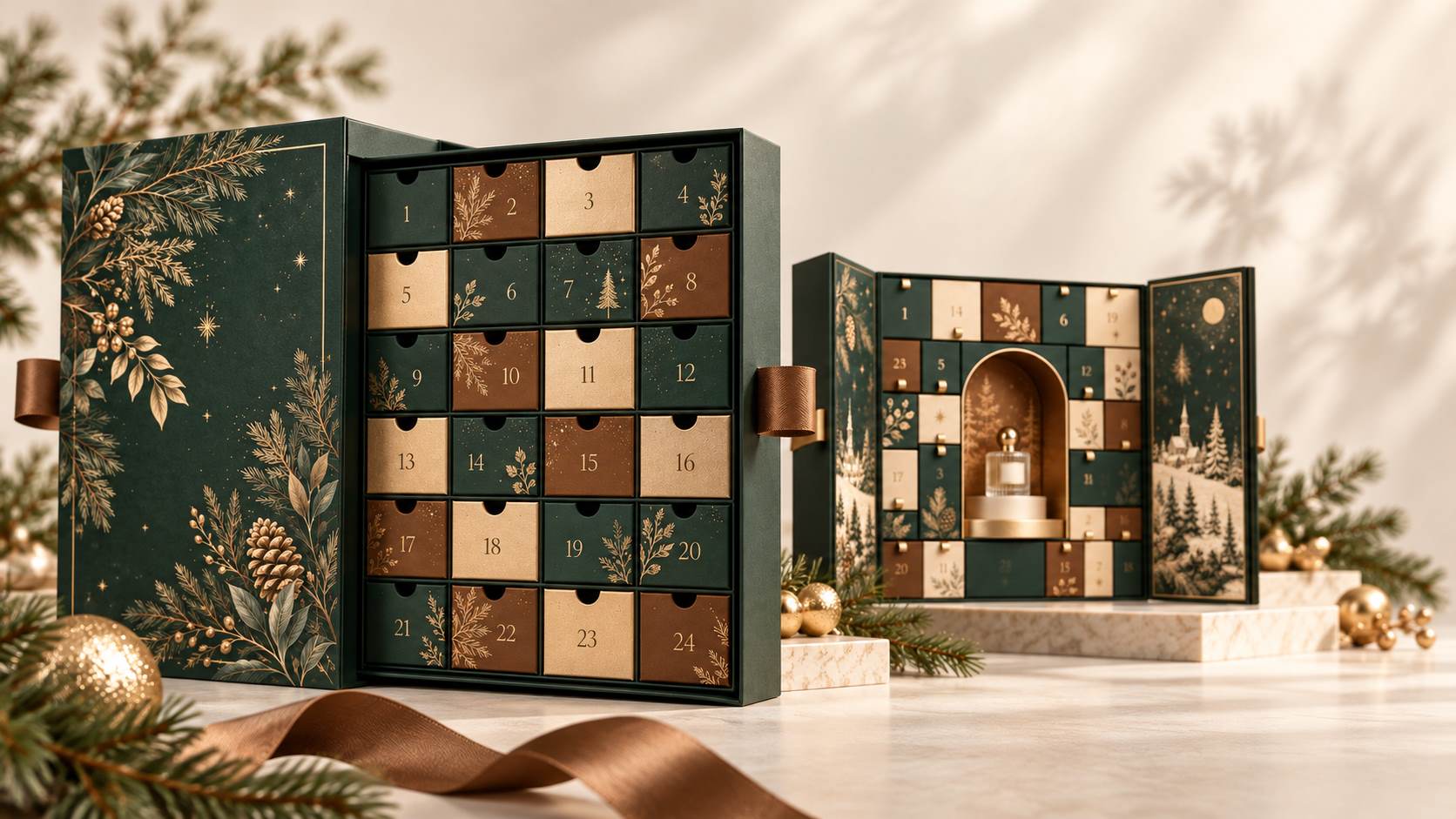

A Christmas advent calendar is not simply a gift box with 24 numbers printed on the front. For brands, it is a seasonal packaging system that must organize multiple products, create a satisfying daily reveal, protect every item during transportation, support efficient filling, and still arrive in time for a fixed Christmas sales window. That makes custom advent calendar packaging one of the more demanding paper-packaging projects to develop well.
The strongest projects begin with the products rather than the artwork. Product dimensions, weight, quantity, compartment count, opening style, insert requirements, finishing, filling method, shipping destination, and launch timing all influence the final structure.
A custom Christmas advent calendar box should be designed around the actual product assortment, not forced into a standard layout. The most effective solution balances product fit, structural stability, consumer experience, manufacturing efficiency, seasonal timing, and total cost. For brands planning beauty, fragrance, chocolate, jewelry, lifestyle, toy, wellness, or corporate gift calendars, early structural development and physical sampling can significantly reduce production risk before bulk manufacturing begins.
What Makes a Custom Christmas Advent Calendar Box Different from Standard Gift Packaging?
A custom Christmas advent calendar box is more complex than standard gift packaging because it must manage multiple products, individual compartments, repeated opening, product protection, visual presentation, and seasonal delivery within one coordinated structure. Unlike a normal gift box that is usually opened once, an advent calendar may be used every day for 12, 24, or 25 days. Its structure must therefore remain functional and visually organized throughout the entire countdown.
One Package May Need to Hold 12, 24, or More Different Products
Many advent calendars contain multiple SKUs rather than identical products.
A beauty or fragrance calendar, for example, may include:
- Serum bottles
- Lipsticks
- Cream jars
- Perfume samples
- Makeup brushes
- Sheet masks
- Small accessories
- Travel-size skincare products
These items may have completely different dimensions, weights, shapes, and protection requirements.
Before designing the calendar, it is useful to define:
- Final packed dimensions of every product
- Product weight
- Preferred orientation
- Fragility
- Whether each item already has individual packaging
- Required protection
- Ease of removal
- Whether products can move during transportation
If all compartments are designed around the largest product, the finished calendar can become unnecessarily large.
That extra space increases more than paper consumption. It can also affect export carton dimensions, warehouse space, assembly labor, pallet use, and international freight.
A more efficient structure is usually designed around the actual assortment.
Long cosmetic tubes may work better in narrow vertical compartments. Cream jars may require wider but shallower cavities. Flat sachets can use thin sections. Larger hero items can occupy dedicated spaces rather than determining the depth of the entire calendar.
For mixed-size product sets, a drawer box, book style box, or customized multi-compartment structure may offer more flexibility than a uniform grid.
The structure should adapt to the products rather than forcing every product into the same cavity.
The Box Must Continue Working After Repeated Opening
A standard gift box may only need to create one strong opening moment.
An advent calendar has to perform repeatedly.
Customers may open one compartment each day for several weeks, which means structural details become more noticeable over time.
Common problems include:
- Drawers becoming difficult to open
- Loose drawers reducing the premium feel
- Perforated doors tearing beyond the intended opening
- Products moving inside oversized compartments
- Inserts becoming loose
- Numbering not aligning correctly
- Internal partitions bending after products are removed
- The outer structure losing stability as the calendar becomes lighter
These issues matter especially when developing premium rigid box structures.
A beautiful foil logo cannot compensate for a drawer that sticks. Expensive paper cannot compensate for products rattling inside oversized cavities.
This is why custom packaging inserts should be considered during structural development rather than treated as an accessory added at the end.
A well-developed calendar should perform properly on Day 1 and still feel controlled on Day 24.
Advent Calendar Packaging Is Part of the Product Experience
A traditional gift box mainly protects and presents a product.
Custom advent calendar packaging often performs several functions at once:
- Product protection
- Multi-SKU organization
- Brand presentation
- Daily product discovery
- Christmas gifting
- Storytelling
- Social-media unboxing
- Reusable storage
Because customers interact with the packaging repeatedly, the structure becomes part of the product experience.
A drawer may be useful because it creates a stronger reveal and allows products of different sizes to be organized efficiently. A perforated-door structure may be more suitable when the products are lightweight and production efficiency is important. A folding rigid box can be considered when a premium structure is required but shipping volume also matters.
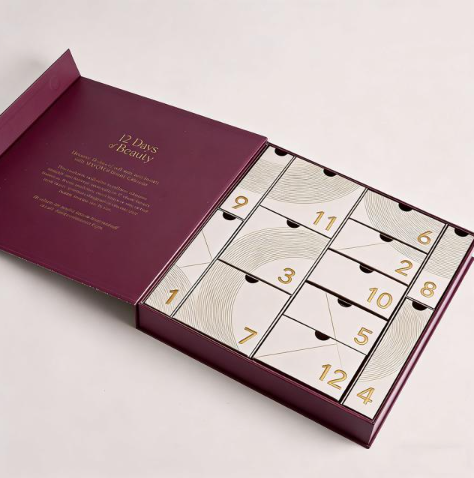
For higher-end gift collections, a magnetic box or book-opening format can create a stronger presentation when the packaging is expected to function as both a gift and a long-term display piece.
Seasonal Timing Changes the Risk Profile
Christmas packaging has a fixed commercial window.
A year-round gift box that arrives late may still be sold later. A Christmas advent calendar that misses its seasonal sales period can lose a large part of its commercial value.
Development may need to coordinate:
- Product confirmation
- Structural design
- Compartment planning
- White sampling
- Product-fit testing
- Printed sample approval
- Material preparation
- Printing
- Finishing
- Die cutting
- Assembly
- Quality inspection
- Product filling
- International shipping
- Warehouse receiving
- Retail or e-commerce launch
This is why seasonal projects should be planned backward from the actual launch date rather than from December 25.
A professional custom packaging manufacturer should evaluate whether a design can not only be produced, but also sampled, assembled, inspected, packed, and delivered within the required project window.
Which Custom Advent Calendar Box Structures Work Best for Different Christmas Product Sets?
The best custom advent calendar box structure depends on product size, weight, number of SKUs, target price, opening experience, shipping requirements, and brand positioning. Door-style calendars can work well for lightweight products and high-volume campaigns, while drawer, book-style, double-door, mini-box. The folding rigid structures offer more flexibility for premium or mixed-size product assortments.
Door-Style Advent Calendar Boxes
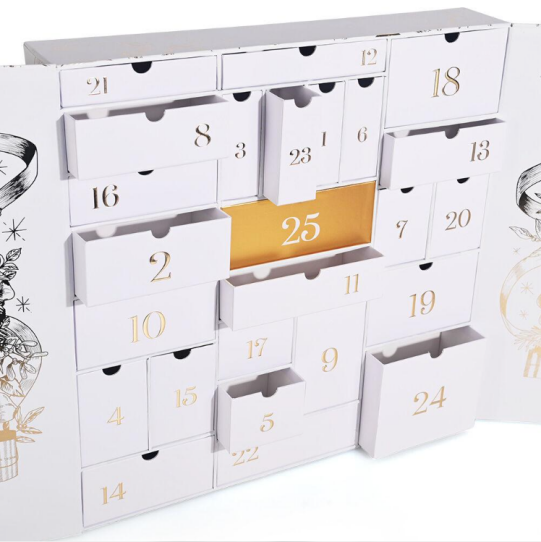
Door-style advent calendars are one of the most familiar formats.
A printed outer panel contains numbered perforated or die-cut openings. Behind each door is an individual cavity, tray, compartment, or wrapped product.
This format can be suitable for:
- Chocolate
- Tea
- Coffee capsules
- Lightweight cosmetics
- Samples
- Small accessories
- Promotional products
The main advantage is efficiency.
A single printed front structure can create the countdown experience without manufacturing 24 separate drawers.
This can help reduce:
- Component count
- Assembly complexity
- Material consumption
- Packing time
- Unit cost
However, the structure becomes more difficult when the products vary significantly in size or depth.
If Day 5 contains a flat sachet but Day 12 contains a deep jar, a standard cavity layout may not use space efficiently.
Drawer-Style Advent Calendars
A drawer-style calendar uses separate drawers or mini boxes arranged inside a rigid outer structure.
This format is commonly considered for:
- Beauty collections
- Fragrance
- Jewelry
- Premium chocolate
- Wellness products
- Lifestyle gifts
- Corporate gifting
A drawer gives the customer a more deliberate daily interaction.
Pulling out a numbered drawer also gives the brand additional surfaces for messaging, product descriptions, illustration, color coding, and seasonal storytelling.
The main trade-off is complexity.
More drawers mean more components, more folding, more assembly, more inspection points, and potentially higher labor cost.
For mixed-size products, however, drawers can solve a major engineering problem because each drawer can be sized according to its contents.
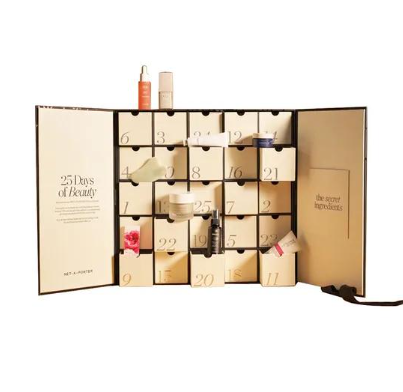
Book-Style and Double-Door Calendars
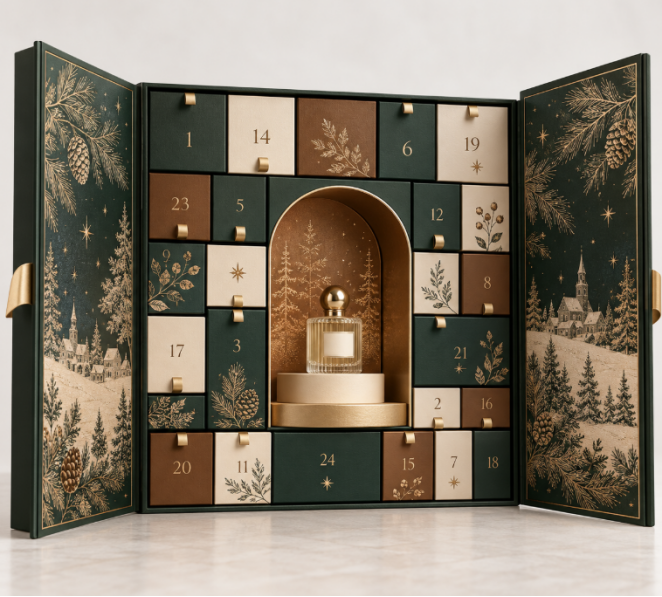
A book style box or double-door format is often used when presentation is a major part of the product value.
Opening the package can reveal:
- Multiple drawers
- Mixed compartments
- A central hero product
- Printed interior graphics
- Brand storytelling
- Decorative panels
This can work particularly well for fragrance, premium beauty, jewelry, gourmet gifting, luxury accessories, and limited-edition collections.
The important question is not whether the structure looks impressive.
The question is whether the doors contribute to product organization, opening experience, and brand presentation.
If they only make the packaging larger, the brand may be paying for complexity without gaining enough value.
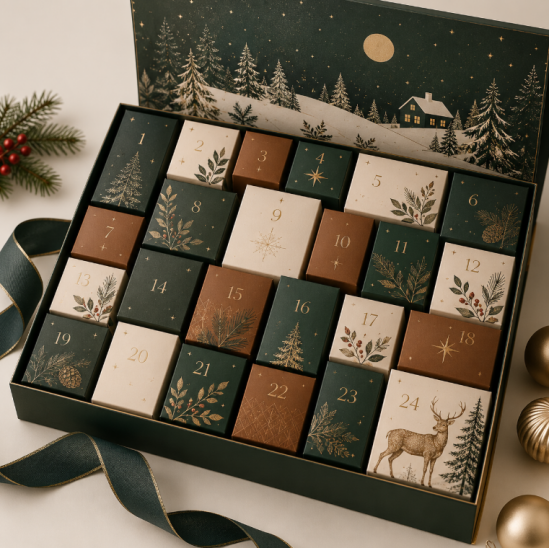
Mini-Box Advent Calendars
Individual mini boxes are especially useful for mixed-size product assortments.
A calendar could contain 24 different cartons, each sized for the product inside.
Advantages include:
- Better fit for different SKUs
- Additional branding surfaces
- Flexible numbering
- Easy product identification
- Strong daily reveal
- Potential reuse of individual cartons
The disadvantage is assembly.
Twenty-four individual cartons can create substantial folding, loading, sequencing, and inspection work.
This format is most effective when the additional interaction and presentation justify the extra operational complexity.
Foldable Rigid Advent Calendars
A folding rigid box can be useful when the calendar needs a premium structure but export volume is a concern.
Traditional rigid boxes are shipped in their final three-dimensional form.
A foldable rigid structure can reduce shipping and storage volume before final assembly.
This may be especially useful when:
- The box has a large footprint
- Production and filling occur in different locations
- International freight is significant
- Warehouse space is limited
- Local assembly is available
The freight saving should always be compared with the additional labor required for final assembly.
Lower shipping volume does not automatically mean lower total project cost.
How Can Custom Advent Calendar Packaging Be Engineered for 12, 24, or Mixed-Size Products?
Custom advent calendar packaging should be engineered from the actual products inward. Every SKU should be measured in its final packed condition, grouped by size and depth, then arranged to minimize wasted space while maintaining easy removal and sufficient protection. For mixed-size products, the calendar may use different cavity sizes, individual drawers, stepped layouts, mini boxes, or multiple insert zones rather than one uniform grid.
Measure the Final Packed Product First
Product dimensions should be confirmed before the final box dimensions.
For every SKU, measure the item exactly as it will enter the calendar.
That may include:
- Cap
- Sleeve
- Individual carton
- Label
- Protective bag
- Tissue
- Wrapper
- Secondary packaging
A perfume bottle may be 30 mm wide, but its individual carton may be 42 mm wide.
If only the bottle is measured, the final cavity may be unusable.
Weight is equally important.
If several heavy products sit on one side, the calendar may feel unbalanced when lifted. In drawer structures, uneven weight can also affect how the outer shell performs.
Avoid Designing Every Compartment Around the Largest Product
One oversized SKU should not automatically determine the dimensions of the entire calendar.
Suppose one item is 70 mm deep while the other 23 are only 25 mm deep.
Making the entire calendar 70 mm deep could create a large amount of empty volume.
Alternative solutions may include:
- Rotating the large item
- Placing it horizontally
- Giving it a dedicated drawer
- Using a stepped insert
- Positioning it in a central hero compartment
- Creating multiple depth zones
This is where structural engineering can create real cost savings.
A smaller outer box can reduce:
- Board consumption
- Wrapping paper
- Insert material
- Export carton volume
- Pallet count
- Freight
- Warehouse space
Plan Mixed-Size Compartments as a System
A practical layout process may include:
- Measure every SKU.
- Group products by footprint.
- Group products by depth.
- Identify heavy or fragile items.
- Test horizontal and vertical orientation.
- Create rough layout zones.
- Add finger access.
- Add structural walls.
- Include manufacturing tolerances.
- Check weight balance.
- Build a white sample.
- Load real products into the sample.
This approach often reveals opportunities that are not obvious in a digital rendering.
For example, a narrow tube may use space between two wider compartments. Flat sachets may occupy a shallow back section. A large central product can become a focal point rather than a structural problem.
Leave Enough Clearance Without Making the Product Feel Loose
There is no single clearance value that works for every advent calendar.
The correct tolerance depends on product shape, board thickness, insert material, surface friction, filling method, product variation, opening direction, and removal method.
Too little space can make loading difficult.
Too much space can make products feel poorly controlled.
For highly precise positioning, an EVA insert may be suitable. For projects focused on paper-based structures, a paperboard insert can create a cleaner material system.
The correct choice depends on protection, sustainability goals, budget, and presentation.
Consider Filling Efficiency Before Finalizing the Layout
A calendar that is easy for the customer to open may still be difficult for the factory or fulfillment team to pack.
Imagine a 24-product calendar with 24 nearly identical drawers.
If products are loaded into the wrong numbered compartment, the entire countdown sequence may become incorrect.
The layout should therefore consider:
- Product sequence
- Numbering
- Loading direction
- Packing instructions
- Drawer identification
- Inspection method
- Rework risk
For higher-volume orders, even a few extra seconds of packing time per unit can become significant.
A good structure should work for the customer and the production team.
What Materials, Inserts, and Finishes Are Best for Premium Christmas Advent Calendar Packaging?
The best materials and finishes for premium Christmas advent calendar packaging depend on product weight, structural requirements, brand positioning, target price, sustainability goals, and shipping conditions. Greyboard is often used for premium rigid structures, paperboard for lighter folding formats, and corrugated board for larger or heavier calendars. Inserts may use paper, EVA, foam, flocking, molded pulp, or formed trays depending on protection and presentation needs.
Greyboard for Premium Rigid Structures
Greyboard is commonly used as the structural core of premium rigid packaging.
It can create strong side walls, stable drawer systems, book-style structures, double-door calendars, and reusable packaging.
The greyboard is typically wrapped with printed paper, specialty paper, or another decorative surface.
The correct board thickness depends on calendar dimensions, total product weight, drawer configuration, opening method, and required stiffness.
Using thicker board than necessary does not automatically improve the design.
It may increase weight and shipping cost without creating a meaningful customer benefit.
Paperboard for Lighter Calendar Structures
Paperboard can work well for door-style calendars, chocolate calendars, tea calendars, cosmetic sampling sets, promotional calendars, and lightweight gift collections.
Its advantages include efficient printing, die cutting, folding, lower material weight, and compact transportation.
A well-engineered paperboard calendar can still feel premium when the proportions, print quality, finishing, and opening experience are controlled carefully.
Corrugated Board for Larger or Heavier Products
Corrugated board can provide additional strength for large calendars, heavier product sets, shipping-sensitive projects, and larger gift collections.
It may be used as an internal reinforcement or as a visible material depending on the desired visual style.
For natural, eco-focused, or direct-to-consumer brands, exposed kraft or corrugated structures can also support a more understated design direction.
Insert Options
The insert should hold each product securely while keeping it easy to remove.
Common options include:
- Paperboard partitions
- Folded paper inserts
- EVA insert
- Foam
- Flocked inserts
- Molded pulp
- Formed plastic trays
- Individual mini boxes
The best option depends on the product.
A glass fragrance bottle may need more precise support than a wrapped tea sachet.
Jewelry may benefit from a soft or flocked surface.
Chocolate may require food-contact considerations.
A product already packed in its own carton may only require a simple divider.
Paper Inserts vs EVA vs Formed Trays
Paper inserts can provide lightweight construction, a paper-based appearance, printing opportunities, and easy integration with cartons.
EVA can provide precise product positioning, strong cushioning, and clean premium presentation.
Formed trays can provide consistent cavities, efficient loading, and clear visual organization.
No insert material should be selected only because it looks premium.
The insert should solve a product problem.
Finishing Options for Advent Calendar Packaging
Premium finishes can enhance the seasonal experience when they are used with restraint.
Common options include:
- foil stamping
- embossing
- Debossing
- Spot UV
- Matte lamination
- Gloss lamination
- Soft-touch lamination
- Specialty paper
- Texture paper
- Silk screen printing
- Ribbons
- Magnetic closures
A luxury beauty calendar may combine textured paper with controlled foil details.
A playful cosmetic calendar may use bold CMYK artwork and colorful drawers.
A natural wellness calendar may rely on uncoated paper, kraft textures, and minimal printing.
A corporate gift calendar may prioritize clean branding, consistent colors, and smooth opening.
The most effective finishing system supports the brand rather than competing with it.
Avoid Over-Finishing
Using foil, embossing, spot UV, ribbon, magnets, specialty paper, and multiple lamination effects on the same box does not necessarily make it more premium.
Complex finishing can increase production cost, sample complexity, production time, quality-control points, and risk of inconsistency.
Premium perception often comes from precision.
Clean wrapping, aligned drawers, controlled colors, consistent gaps, accurate numbering, and smooth opening can be more valuable than adding another decorative process.
How Does the Custom Advent Calendar Box Sample and Development Process Work?
The custom advent calendar box development process normally moves from product information and structural planning to white samples, product-fit testing, printed samples, finishing confirmation, and final production approval. Sampling is especially important for advent calendars because the supplier is not only testing appearance. The structure must also prove that every product fits, drawers or doors work correctly, inserts remain stable, and the calendar can be assembled consistently.
Step 1: Product Information and Project Brief
A useful project brief should include:
- Product list
- Product dimensions
- Product weights
- Quantity
- Number of compartments
- Reference images
- Preferred structure
- Target market
- Artwork status
- Filling location
- Shipping destination
- Target launch date
- Budget range if available
The customer does not need to know every technical answer.
Accurate product information is more important than arriving with a fully engineered box.
Step 2: Structural Planning
The structure is developed around product layout, day count, product size differences, weight distribution, opening method, insert type, target appearance, and shipping considerations.
At this stage, different formats may be compared before finalizing the dieline.
Step 3: White Sample
A white sample is one of the most useful tools in advent calendar development.
It can help confirm overall dimensions, drawer size, door position, product fit, insert fit, structural balance, and opening experience.
There is little value in perfecting decorative details before confirming that the products actually fit.
Step 4: Product-Fit Testing
Real products should be placed into the sample whenever possible.
Check whether every cavity is correct, the product can be removed easily, products move, heavy items are supported, the box remains balanced, and fulfillment staff can load it efficiently.
This step often identifies problems that are invisible in CAD drawings.
Step 5: Printed Sample
After the structure is confirmed, a printed sample can be used to evaluate artwork position, numbering, color direction, logo, interior printing, finishing, and material appearance.
For complex or premium projects, a production-quality sample may be required before bulk manufacturing.
Step 6: Final Approval Before Bulk Production
Final approval should clearly cover structure, product fit, material, print, color, finish, insert, accessories, assembly, and packing method.
This creates a stronger reference standard for bulk production.
AKpack can support different sample stages, including structural samples, printed samples, and pre-production confirmation as part of the broader packaging development process.
What Affects Custom Advent Calendar Box Price and Production Cost?
Custom advent calendar box price is affected by more than external size and quantity. Compartment count, box structure, board thickness, number of drawers, insert type, printing, finishing, accessories, assembly labor, product filling requirements, packaging method, and order volume all influence cost. A simple 24-door paperboard calendar and a 24-drawer rigid calendar may look similar in size but have very different manufacturing requirements.
Structure Has a Major Effect on Price
Compare three concepts: a 24-door folding carton calendar, a 24-drawer rigid calendar, and a book-style calendar containing 24 individual mini boxes.
All three may hold the same products, but they differ in component count, material use, die cutting, folding, hand assembly, wrapping, inspection, filling, and packing.
This is why price comparison should only happen after the main structure is defined.
Quantity Affects More Than Unit Price
Higher quantities can distribute setup and tooling costs across more units.
However, quantity also affects material purchasing, production scheduling, assembly capacity, warehouse planning, inspection, and shipping.
For custom projects, MOQ should be considered together with market-testing risk.
AKpack supports custom packaging projects from 500 pieces, making it possible for suitable brands to begin with a controlled production quantity before scaling into larger repeat orders.
Inserts Change the Cost Structure
A simple paper divider may be inexpensive.
A precision-cut EVA system, flocked insert, or custom formed tray may involve tooling, additional materials, separate manufacturing, and more assembly.
If the product already has strong individual packaging, a simpler insert may provide enough protection.
The best solution is the one that provides sufficient protection without unnecessary complexity.
Finishing Can Add Cost Quickly
Processes such as foil stamping, embossing, spot UV, soft-touch lamination, ribbons, magnets, and specialty paper can create strong visual impact.
But adding multiple processes also increases setup, sampling, production operations, and quality-control requirements.
A strong design often uses fewer finishes more deliberately.
Assembly Is an Important Cost Factor
Advent calendars can be labor-intensive.
A calendar with 24 drawers, 24 ribbons, 24 individual products, multiple inserts, and different compartment sizes requires much more assembly than a simple folding carton.
The cost conversation should therefore include not only materials but also how the finished calendar will be built and filled.
Shipping Volume Should Be Part of the Price Discussion
The lowest ex-factory unit price may not create the lowest landed cost.
A large rigid calendar can require significantly more export volume than a compact folding structure.
Brands should evaluate unit cost, export carton size, units per carton, shipping volume, warehouse volume, and assembly location.
The best commercial solution is often the structure that balances presentation with total supply-chain cost.
When Should Christmas Advent Calendar Box Production Start for Seasonal Launches?
Christmas advent calendar box production should be planned backward from the actual retail or e-commerce launch date. The timeline must allow for structural development, sampling, revisions, material preparation, printing, finishing, assembly, quality inspection, product filling, transportation, and warehouse receiving. Complex drawer calendars and mixed-product gift sets generally require more planning than simple paperboard door-style calendars.
Do Not Use Christmas Day as the Deadline
If the calendar is intended to sell in October or November, the project must be ready well before December.
The finished product may need to arrive at a warehouse weeks before launch.
Before that, the calendar may need to be filled, inspected, shipped, produced, sampled, approved, and designed.
That creates a long chain of dependencies.
Start Structural Development Early
Early structural development provides more room for white sample testing, product changes, insert adjustment, artwork refinement, material selection, finishing trials, and production planning.
Late structural changes can affect the entire project.
A product that suddenly increases in size may require a new insert, a larger drawer, a revised outer box, new artwork, and different export cartons.
Protect Time for Sampling
Sampling should not be treated as an optional delay.
It is a risk-control stage.
A physical sample can identify product-fit problems, difficult opening, weak partitions, oversized cavities, incorrect numbering, color issues, and finishing problems.
Solving these problems before mass production is usually easier than solving them afterward.
Allow Time for Assembly
Assembly is particularly important for complex advent calendars.
Rigid drawer systems, mini boxes, book-style structures, ribbons, magnets, and inserts all add manufacturing steps.
Seasonal production schedules should therefore be based on real assembly capacity rather than printing time alone.
Plan for Shipping and Warehouse Receiving
The factory completion date is not the same as the launch date.
Brands should consider ocean freight, air freight, customs, port congestion, local trucking, warehouse booking, fulfillment, and retail distribution.
A strong seasonal packaging plan includes buffer time rather than assuming that every stage will move perfectly.
How Does an Advent Calendar Box Manufacturer Prevent Production and Quality Problems?
An experienced advent calendar box manufacturer reduces production risk by controlling the project before, during, and after manufacturing. Quality control should cover materials, printing, finishing, dimensions, compartment fit, drawer movement, insert stability, assembly, numbering, and final packing. For complex calendars, consistency matters because one small structural error may be repeated across hundreds or thousands of units.
Confirm Specifications Before Production
Production should begin with a clear approved standard.
This may include final dimensions, board specification, paper, print file, Pantone colors, finishing location, insert material, drawer size, number sequence, accessories, and packing method.
Clear specifications reduce interpretation during manufacturing.
Check Materials Before Assembly
Material inconsistency can affect box stiffness, color, wrapping, folding, drawer fit, and surface finishing.
Incoming materials should therefore be checked before they enter later production stages.
Control Printing and Finishing
Color variation can be especially visible on premium Christmas packaging.
Brands may use Pantone colors, large solid-color areas, metallic foil, fine illustrations, and repeated numbered graphics.
Production control should check color consistency, print registration, foil position, embossing position, lamination quality, surface scratches, and glue marks.
Test Structural Fit
A finished calendar should be tested for drawer movement, door opening, insert fit, product fit, magnetic closure, ribbon position, and outer-box stability.
The structure should feel consistent across the production batch.
Check Numbering and Product Sequence
Advent calendars have a quality-control issue that many ordinary boxes do not have: sequence.
If the packaging uses 24 numbered compartments, errors can include missing numbers, duplicate numbers, incorrect drawers, incorrect products, and the wrong sequence.
Inspection should therefore include not only box quality but also packaging logic.
Inspect Final Packing
Before shipment, cartons should be checked for correct quantity, external protection, product orientation, export carton strength, labeling, and pallet or carton arrangement where required.
AKpack integrates production, assembly, and quality inspection within its packaging service process, supporting brands from sample confirmation through bulk manufacturing and delivery preparation.
Why Choose AKpack as Your Custom Advent Calendar Box Manufacturer and Factory?
AKpack supports brands that need more than a standard box supplier. Custom Christmas advent calendar projects can involve structural development, different product sizes, specialized inserts, premium finishing, complex assembly, sampling, and strict seasonal delivery. AKpack combines packaging development, materials, printing, finishing, assembly, inspection, and production support to help turn an initial concept into a production-ready packaging solution.
Custom Structural Development
Brands can begin from a reference image, existing sample, product dimensions, dieline, artwork, or initial concept.
The structure can then be developed around the actual products and target presentation.
Available box directions may include:
- drawer box
- rigid box
- book style box
- magnetic box
- folding rigid box
- Door-style calendars
- Double-door calendars
- Mini-box systems
- Mixed-compartment structures
Material and Insert Customization
Depending on product needs, packaging can be developed using different paper and board materials together with customized insert solutions.
Insert options may include:
- paperboard insert
- EVA insert
- Flocked insert
- Foam insert
- PET tray
- Customized partitions
The purpose is to create the right balance between protection, appearance, sustainability, and cost.
Printing and Premium Finishing
Available decoration and surface options can include:
- CMYK printing
- Pantone color matching
- foil stamping
- embossing
- Debossing
- Spot UV
- Matte lamination
- Gloss lamination
- Soft-touch lamination
- Specialty papers
- Silk screen printing
Finishing can be selected according to the brand rather than applied as a fixed package.
Sample Development Before Production
Sampling can be used to verify product fit, internal layout, drawer movement, opening, insert, material, print, finishing, and assembly.
This gives brands a physical basis for approval before bulk production begins.
Production and Quality Control
Advent calendars require consistency across many components.
Production control can focus on material quality, printing, finishing, dimensions, wrapping, compartment fit, drawer movement, numbering, assembly, and packing.
This is particularly important when the calendar contains many individual parts.
Support for Growing Brands and Repeat Programs
A Christmas calendar may begin as a seasonal project and later develop into annual Christmas collections, beauty launches, limited editions, corporate gifting programs, new product campaigns, and multi-product gift systems.
Working with one packaging partner across sampling, production, and future development can reduce the need to rebuild the entire packaging process for every new launch.
What Should You Prepare for a Custom Advent Calendar Project?
To begin a custom project, prepare as much of the following information as possible:
- Product list
- Product dimensions
- Product weight
- Product photos
- Number of days
- Preferred structure
- Order quantity
- Artwork or brand direction
- Target market
- Filling location
- Shipping country
- Target launch date
- Reference packaging if available
If the final structure has not yet been decided, that is not a problem.
The most important starting point is accurate product information and a clear project objective.
A well-developed custom Christmas advent calendar should do more than hold products. It should help the brand organize a complex product assortment, create a memorable daily experience, protect the contents, support efficient production, and arrive in time for the seasonal opportunity.
For brands planning a new Christmas collection, early collaboration with an experienced custom packaging manufacturer can help identify structural, sampling, production, and logistics issues before they become expensive problems.