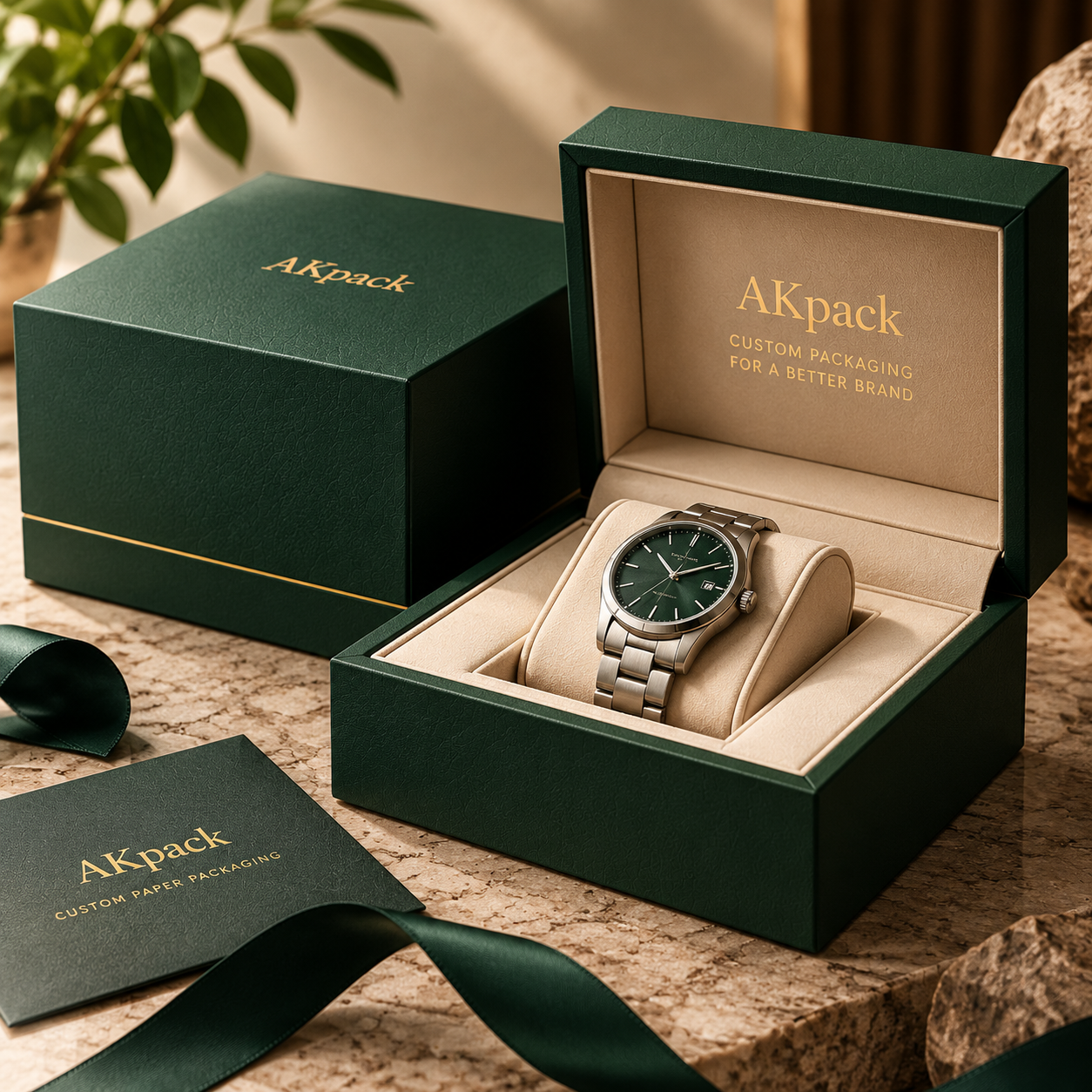

A watch box is more than a container for a timepiece. It is part of the product presentation, reinforcing brand identity and shaping the customer’s first impression. For watch brands, retailers, and corporate gift suppliers, packaging needs to combine a distinctive appearance with a practical structure, a well-fitted interior, and consistent production quality.
Custom watch boxes allow brands to align packaging with product dimensions, visual guidelines, presentation requirements, and budget.
AKpack is a custom paper packaging manufacturer based in Dongguan, China. Our services include packaging design development, material selection, printing, surface finishing, sampling, assembly, quality inspection, and export delivery. We work with customers to turn packaging references, artwork, and product requirements into defined specifications for development and production.
Whether you are preparing a new watch collection, developing branded gift packaging, or updating the presentation of an existing product line, a clear understanding of your packaging requirements provides a practical starting point. The following sections explain how to define your project, select suitable customization options, prepare samples, and request a quotation.
1. Custom Watch Boxes Tailored to Your Brand and Product Requirements
A successful custom watch box project begins with the product and the brand, not simply with choosing a box from a catalog.
For a brand developing a new collection, this may mean creating a consistent appearance across several watch models. For a retailer or corporate gifting company, it may mean adapting the packaging to a specific product, campaign, or presentation requirement. Each project can require a different combination of structure, material, interior layout, and branding.
Custom Watch Box Packaging for Different Brand Requirements
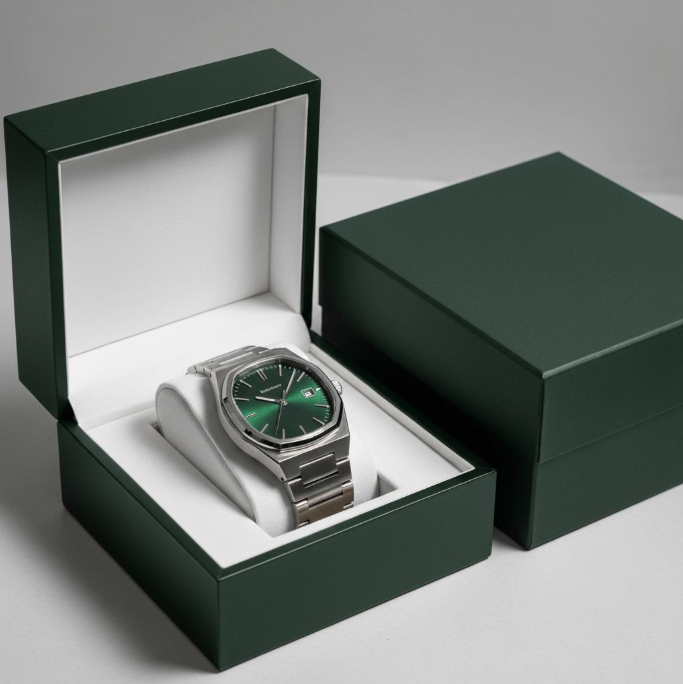
Before choosing the box structure, establish the role of the packaging in your sales and distribution process.
- Retail presentation: Focus on a clear brand identity, a refined exterior, and an interior that presents the watch neatly.
- Gift packaging: Consider the opening experience, coordinated materials, and space for relevant accessories or brand information.
- Product launches: Align the box design with the collection’s visual identity and any accompanying promotional materials.
- E-commerce orders: Consider the relationship between the presentation box and the protective shipping packaging.
- Multi-model collections: Plan how different watch sizes or styles can share a consistent packaging system without compromising fit.
These requirements influence more than appearance. They can affect box dimensions, insert construction, material selection, assembly, and the amount of space needed for accessories or documentation.
For example, a box intended for a single watch may require a carefully positioned cushion and a clean presentation area. A package containing a watch and an additional strap may need separate compartments.
What Information Helps Define a Custom Watch Box Project?
You do not need to have every design detail finalized before discussing your project. A reference image, product photograph, sketch, existing package, or preliminary design file can help establish a direction.
Where available, prepare the following information:
- Watch case dimensions and overall thickness.
- Strap or bracelet type, including the clasp configuration.
- The number of watches and accessories per box.
- Preferred external dimensions or a reference box style.
- Logo artwork, brand colors, and visual guidelines.
- Preferred paper materials, interior finishes, and branding effects.
- Estimated order quantity, target budget, and required delivery date.
If some information is not yet available, the initial discussion can identify what needs to be measured, designed, or confirmed before sampling. Clear project requirements help reduce avoidable revisions and provide a more reliable basis for quotation.
2. Custom Watch Box Design: Box Structures, Materials, and Interior Inserts
The structure, exterior material, and interior insert work together to determine how a custom watch box looks and functions.
AKpack develops customized paper packaging based on customer requirements. For a watch box project, the suitable combination depends on the watch dimensions, intended presentation, preferred appearance, quantity, and production feasibility.
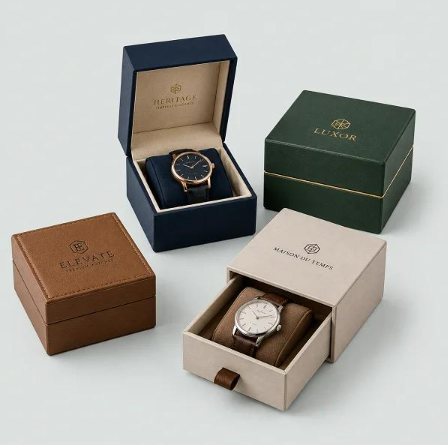
Which Watch Box Structures Can Be Considered for Custom Packaging?
Different structures offer different presentation and access experiences.
- Rigid presentation boxes: A structured option for brands seeking a defined shape and a refined presentation.
- Magnetic-closure boxes: Suitable for designs that call for a clean opening experience and a coordinated lid structure.
- Hinged-lid or book-style boxes: Allow the lid and base to remain connected, depending on the selected construction.
- Drawer boxes: Provide a sliding opening style and may be suitable for selected gift or presentation concepts.
- Lid-and-base boxes: Offer a separate lid and base for a classic presentation format.
- Folding rigid boxes: May help reduce storage space before assembly, depending on the structure and project requirements.
These are structural directions to evaluate, not a claim that every configuration is suitable for every watch.
If your project requires a particular opening style, the structure should be reviewed alongside the complete packaging specification. A visually appealing concept may need adjustments to improve access, alignment, or assembly.
You can also explore related custom rigid boxes, magnetic closure boxes, and drawer boxes for additional paper packaging formats, where these categories match your project requirements.
How Should You Select Exterior Materials for Custom Watch Boxes?
Material selection influences appearance, surface texture, print quality, structural performance, and cost. For paper-based rigid packaging, the exterior wrapping paper and the structural board perform different roles.
Common material options supported by AKpack’s packaging capabilities include:
| Material | Typical role | Key considerations |
| Greyboard | Structural support for rigid boxes | Board thickness, box size, rigidity, and edge finishing |
| Coated paper | Printed exterior or wrapping material | Image quality, color reproduction, and finishing compatibility |
| Specialty paper | Adds distinctive texture or appearance | Surface characteristics, color, and compatibility with finishing |
| White paperboard | Supports selected packaging structures | Board properties, printing requirements, and construction |
| Kraft paper | Provides a natural paper appearance | Brand style, color expectations, and intended use |
| Recycled paper | Supports selected material preferences | Available grades, print requirements, and relevant environmental documentation |
The best material is not necessarily the thickest or most expensive option. A suitable specification balances the required appearance, structure, production process, and budget.
For example, a textured paper may help communicate a restrained, understated brand identity, while a coated surface may be more appropriate for detailed printed graphics. The final selection should be assessed alongside the chosen structure and finishing method.
If your packaging project also includes other paper-based product lines, custom paper packaging can be developed around the wider brand system, subject to the requirements of each product.
How Do Custom Watch Cushions and Interior Inserts Affect Fit?
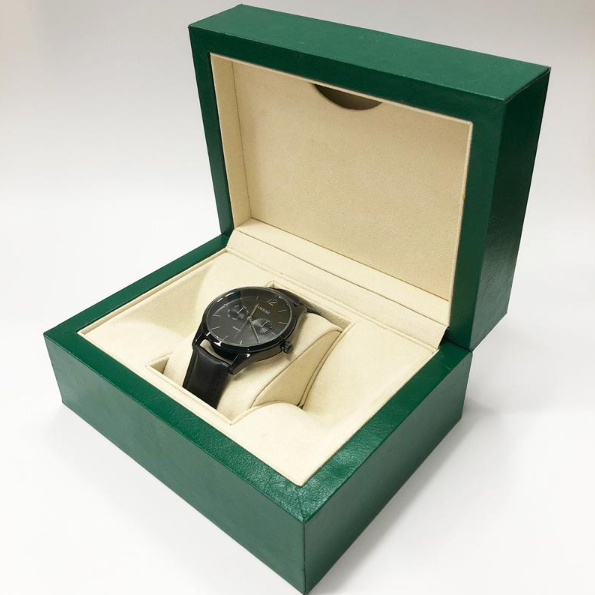
The interior is one of the most important parts of a watch box because it determines how the watch sits inside the package. A suitable insert should support the watch in the intended position, present it neatly, and allow it to be removed without unnecessary force.
The design should consider:
- Watch case diameter and thickness.
- Strap or bracelet length and flexibility.
- Clasp size and position.
- The number of watches or accessories in the box.
- The intended method of placing and removing the watch.
- Contact points between the watch, cushion, and surrounding materials.
Depending on the project, insert options may include paperboard inserts, EVA foam, sponge, flocked inserts, or PVC/PET insert trays. The suitable material and construction must be confirmed against the actual product, desired appearance, and applicable requirements.
A cushion that is too tight may make the watch difficult to remove or place unnecessary pressure on the strap. An insert that is too loose may allow unwanted movement. Neither issue can be assessed reliably from an exterior photograph alone.
Where possible, use the actual watch or a dimensionally accurate sample during development. Confirm the fit, contact points, accessory placement, and ease of removal before approving the final sample.
3. Custom Watch Box Printing and Finishes: Foil Stamping, Embossing, and Branding
Printing and surface finishing help translate a brand’s visual identity onto the packaging. The objective is not to use every available effect, but to select the treatments that work with the design, paper surface, logo artwork, and budget.
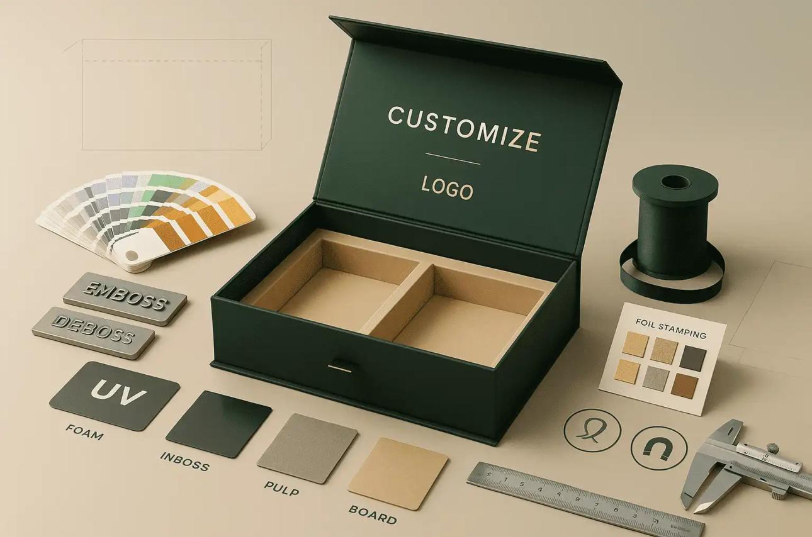
AKpack’s documented packaging capabilities include CMYK printing, spot-color printing, Pantone color matching, digital printing, matte and gloss lamination, soft-touch lamination, UV coating, spot UV, foil stamping, embossing and debossing, silk-screen printing, and specialty paper effects. The suitability of each process depends on the material, design, specifications, and production requirements of the individual project.
Which Custom Logo Finishes Are Suitable for Watch Boxes?
The right logo treatment depends on the visual result you want to achieve.
| Finishing option | Visual effect | Considerations |
| Gold foil stamping | Adds a gold-toned metallic effect | Artwork detail, paper texture, placement, and foil selection |
| Silver foil stamping | Creates a silver-toned metallic effect | Contrast with the paper and consistency of the logo |
| Embossing | Raises selected design elements | Line detail, material response, and the intended tactile effect |
| Debossing | Presses selected design elements into the surface | Depth, legibility, and paper characteristics |
| Spot UV | Adds a localized coated effect | Contrast, artwork placement, and surface compatibility |
| Silk-screen printing | Applies ink through a screen | Material suitability, ink appearance, and artwork requirements |
| CMYK or spot-color printing | Reproduces brand graphics and colors | Artwork quality, color references, and print specifications |
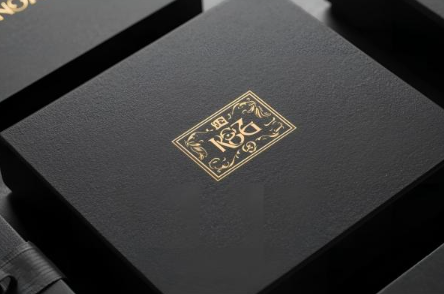
Foil stamping may suit a logo that needs a metallic accent. Embossing or debossing can create a more tactile effect without relying solely on color contrast. Printing may be more appropriate for detailed graphics or artwork that requires multiple colors.
Not every logo is suitable for every finishing method. Fine lines, small lettering, textured paper, and complex artwork may affect the final result. A digital mockup is useful for visual planning, but it cannot fully reproduce the tactile and material characteristics of a finished box.
How Do Paper Textures, Lamination, and UV Finishes Change the Appearance?
Paper texture and surface treatments influence how a box looks under different lighting and how it feels when handled.
Matte lamination can create a subdued appearance, while gloss lamination produces a more reflective surface. Soft-touch lamination is designed to provide a softer surface feel. UV coating and spot UV can add selected surface effects, depending on the design and material compatibility.
Specialty papers can also contribute texture, color variation, or a distinctive surface appearance without requiring multiple decorative treatments. The most suitable combination depends on the brand’s visual direction and the practical requirements of the packaging.
Before confirming a finish, consider:
- Whether the logo remains clear at its intended size.
- Whether the surface effect works with the paper texture.
- Whether the selected colors match the approved reference.
- Whether the finish is appropriate for the expected handling and use.
- Whether the added process is justified by the visual result and budget.
A restrained design with carefully selected materials and one well-executed logo treatment may be more effective than a package with several competing decorative effects.
How Can Custom Finishes Stay Consistent Across a Watch Collection?
Brands with multiple watch models may need packaging that looks consistent across different box sizes or product variants. This requires clear artwork, material, and finishing specifications.
The approved reference should identify relevant details such as logo size, placement, color, paper selection, and the selected surface treatment. If different box sizes are involved, confirm how the logo and other design elements should scale or remain positioned.
Pantone color matching can support defined color requirements where applicable, but the final appearance should still be assessed using the agreed material and production references. Paper color, surface texture, lighting, and finishing can influence the result.
If the packaging is part of a broader brand system, related custom gift boxes and other paper packaging formats can be developed using coordinated visual guidelines where appropriate.
4. Custom Watch Box Sample Development: From Design Brief to Physical Prototype
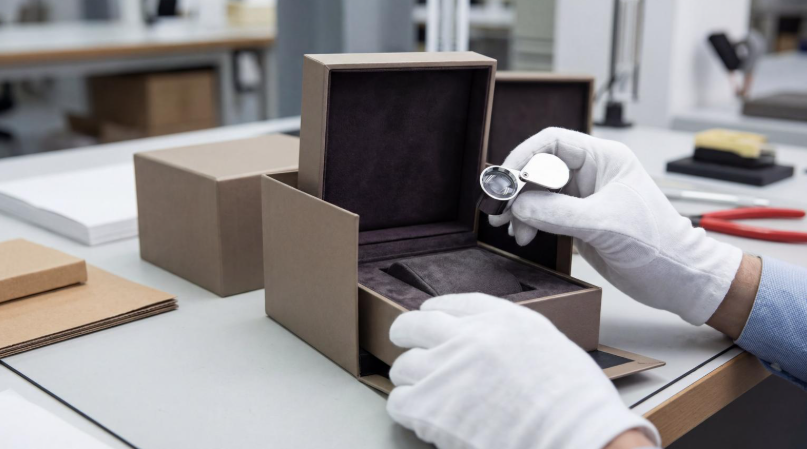
A physical sample allows the proposed design to be checked against the actual product and packaging requirements before bulk production. It helps identify issues that may not be obvious in a drawing or digital rendering, including fit, opening performance, alignment, and the appearance of finishing on the selected material.
AKpack’s packaging development services include structural design, material selection, printing planning, finishing development, insert design, and sample production. The exact development steps depend on the project scope and the information available at the start.
What Should You Prepare Before Requesting a Watch Box Sample?
A clear design brief helps establish the intended result and reduces uncertainty during development.
Where available, provide:
- Watch dimensions, product photographs, or a physical product sample.
- Reference packaging images or a sample of an existing box.
- Desired box structure and opening style.
- Preferred exterior materials and surface finishes.
- Logo artwork and brand color references.
- Interior insert requirements and accessory details.
- Estimated order quantity and target budget.
- Required delivery date and any project deadlines.
If you do not yet have a finished design, a reference image or preliminary sketch can still help explain your expectations. The manufacturer can then identify which details require clarification before a structure or sample specification is finalized.
What Are the Main Stages of Custom Watch Box Development?
1. Requirement review
The project begins with a review of the watch, packaging purpose, design references, quantity, and target budget. Any missing or conflicting information should be clarified before detailed development.
2. Structural development
The proposed box structure and internal layout are developed around the product dimensions and presentation requirements. This stage may involve decisions about opening style, board construction, insert layout, and accessory compartments.
3. Material and finishing selection
Exterior paper, structural board, interior materials, printing, and finishing options are considered together. The selected combination should meet the visual requirements while remaining practical for production.
4. Sample production
A physical sample is prepared according to the agreed development scope. Depending on the project, different sample types may be used to evaluate structure, artwork, materials, or the overall appearance.
5. Sample review and revision
The sample is checked against the project requirements. Feedback should identify specific adjustments to dimensions, fit, artwork, materials, opening performance, or finishing.
6. Specification approval
Before bulk production, the approved version and relevant specifications should be clearly recorded. Any later changes should be documented so that the production team works from the correct information.
How Should You Evaluate a Custom Watch Box Sample?
A sample should be evaluated using the actual watch or a dimensionally accurate model whenever possible.
Structure and dimensions
- Are the external dimensions and internal compartments correct?
- Does the lid, drawer, or closure operate as intended?
- Are the edges, corners, and joints consistent with the agreed design?
Interior fit
- Does the watch sit securely in its intended position?
- Can it be placed and removed without excessive force?
- Are there contact points that may cause unwanted rubbing or pressure?
- Do accessories and documents fit in their intended positions?
Appearance and finishing
- Does the paper match the approved material reference?
- Are the logo position, color, and finishing consistent with the artwork?
- Are there visible marks, uneven finishing, or excess adhesive?
- Does the finished package reflect the intended brand presentation?
Practical use
- Is the box easy to open and close?
- Does the insert remain in the correct position during normal handling?
- Is additional protective packaging required for shipping?
A sample approval should confirm the actual specifications for production, not simply indicate that the package looks attractive in a photograph. Clear feedback and documented revisions help reduce misunderstandings before bulk manufacturing begins.
5. Custom Watch Box Manufacturer: Specification Control and Production Quality
Selecting a manufacturer involves more than comparing product photographs or unit prices. A suitable partner should understand the packaging requirements, communicate clearly during development, and establish a defined specification for the approved product.
AKpack’s company profile describes a packaging operation established in 2016, with 50 employees, four production lines, eight QC personnel, and eight staff members working in the sample room. These figures describe the company’s overall operation; they should not be interpreted as a dedicated watch-box production line or a guarantee of capacity for every project.
What Should You Check When Evaluating a Custom Watch Box Manufacturer?
When comparing manufacturers, consider their ability to support the actual requirements of your project.
- Structural development: Can the proposed dimensions, opening style, and interior configuration be reviewed before sampling?
- Material selection: Can the manufacturer explain the available paper, board, wrapping, and insert options?
- Printing and finishing: Can the requested artwork and surface treatments be evaluated for material compatibility and production feasibility?
- Sampling: Can you review a physical sample before confirming bulk production?
- Specification management: Are the approved dimensions, artwork, materials, and finishing requirements clearly documented?
- Quality inspection: Are the inspection stages and acceptance criteria discussed before production?
- Communication: Are changes, approvals, and unresolved questions recorded clearly?
- Repeat orders: Can the approved specification be used as a reference for subsequent orders, subject to material availability and confirmation?
A product catalog can help establish a manufacturer’s general capabilities, but it does not prove that every structure or finish is suitable for a particular watch box. Request relevant examples or sample references where available, and confirm the specific requirements of your project before placing an order.
Which Specifications Should Be Confirmed Before Bulk Production?
A clear specification helps the manufacturer and customer assess the finished product against the same requirements.
Depending on the project, the approved specification may include:
- External dimensions and relevant internal measurements.
- Board thickness and exterior wrapping material.
- Interior insert material, shape, and placement.
- Logo artwork, size, position, and finishing method.
- Color references and printing requirements.
- Opening and closure requirements.
- Assembly and accessory placement.
- Individual packaging and shipping protection.
Where dimensional or visual tolerances are important, define the applicable acceptance criteria before production. The appropriate criteria depend on the structure, materials, artwork, and intended use of the box.
Changes made after sample approval should be documented and reviewed for their effect on cost, production scheduling, and the approved design. This helps prevent different versions of a specification from being used at the same time.
How Can Quality Checks Help Maintain Consistent Production?
Quality checks should be based on the agreed specification and the characteristics that matter most to the product.
For a custom watch box, these may include checking dimensions, material selection, wrapping quality, logo placement, surface finishing, insert fit, closure operation, assembly, and overall appearance.
The appropriate inspection method and frequency depend on the project and the agreed quality requirements. Customers should discuss the inspection scope, acceptance criteria, and how defects or deviations will be recorded before bulk production begins.
A well-defined process does not eliminate every possible production issue, but it gives both parties a clearer basis for identifying and addressing discrepancies. Consistent specifications, documented approvals, and appropriate inspection help support more predictable manufacturing outcomes.
6. Custom Watch Box Price, MOQ, and Production Lead Time
The price of a custom watch box depends on the complete specification, not simply the external dimensions. Materials, structure, insert design, printing, finishing, order quantity, assembly, sampling, and protective packaging can all affect the final quotation.
Because each project has different requirements, a reliable price should be based on comparable specifications rather than an unsupported general price range.
What Determines the Cost of Custom Watch Boxes?
The main cost factors usually include:
- Box structure: More complex opening mechanisms or compartment layouts may require additional components and assembly.
- Materials: Board thickness, wrapping paper, specialty paper, and interior materials influence material and processing costs.
- Interior inserts: Custom cushions, shaped inserts, and multiple compartments may require additional development and assembly.
- Printing and finishing: Foil stamping, embossing, debossing, UV effects, and other treatments may involve additional setup or processing.
- Order quantity: Quantity affects purchasing, production planning, and how certain setup costs are distributed across the order.
- Sampling and revisions: Sample production and design changes may involve separate development costs, depending on the agreed quotation.
- Packaging and delivery: Individual protection, export cartons, and shipping arrangements may affect the total project cost.
A lower unit price is not necessarily the better option if it excludes required components or does not meet the intended presentation and protection requirements. For an accurate comparison, provide the same dimensions, materials, insert specifications, finishing details, quantity, and packaging requirements to each supplier.
What Is the MOQ for Custom Watch Boxes?
AKpack’s company profile lists a general minimum order quantity of 500 pieces. The applicable MOQ for a specific custom watch box should be confirmed according to the selected structure, materials, finishing requirements, and production arrangements.
If you are developing several watch models, clarify whether each design requires a separate order quantity and whether any specifications or components can be shared across the collection. Similar structures may offer opportunities for coordination, but this should be assessed against the actual design and production requirements.
Before confirming an order, ask whether the quotation includes sampling, tooling or setup charges where applicable, assembly, individual packaging, and export cartons. This helps ensure that the quoted unit price reflects the deliverables you expect.
How Long Does Custom Watch Box Production Take?
The schedule depends on design complexity, material availability, sample revisions, order quantity, production planning, inspection, and shipping arrangements. Sampling and bulk production should be treated as separate stages when planning a project.
A practical schedule should identify the main milestones:
- Requirement and specification confirmation.
- Structural development and material selection.
- Sample production.
- Sample review and any required revisions.
- Approval of the production specification.
- Bulk manufacturing and inspection.
- Packing and shipment.
The actual lead time should be confirmed after the project requirements and production schedule have been reviewed. If your packaging is tied to a product launch or seasonal campaign, share the required delivery date early so that the project can be assessed against that deadline.
How Can You Request an Accurate Custom Watch Box Quote?
To help prepare a useful quotation, provide as much of the following information as possible:
- Watch dimensions or product photographs.
- Reference images, drawings, or an existing packaging sample.
- Preferred box structure and materials.
- Interior insert and accessory requirements.
- Logo artwork and desired finishing effects.
- Estimated quantity per design.
- Target budget and required delivery date.
- Shipping destination and packaging requirements.
If some details remain undecided, identify them clearly. A quotation based on confirmed specifications is more useful than one based on assumptions that may later change.
7. Request a Custom Watch Box Quote from AKpack
If you are developing a new watch collection, refreshing existing packaging, or sourcing a custom paper presentation box, AKpack can discuss the project requirements and help establish a suitable development direction.
Our broader packaging capabilities include structural development, material selection, printing, surface finishing, sampling, assembly, and quality inspection. The specific options for your watch box will depend on the design, materials, order quantity, and production feasibility confirmed for the project.
Share Your Watch Box Requirements
To begin, provide your product dimensions, reference images, preferred materials or finishes, estimated quantity, and target delivery date. If you already have artwork or an existing sample, include it with your inquiry. If the design is still in development, a preliminary brief can help identify the next steps.
For projects involving several watch models, it is helpful to explain whether you need one consistent packaging design or different configurations for each model. This allows the packaging requirements and quotation to be reviewed more accurately.
Discuss Your Custom Watch Packaging Project
A well-developed watch box begins with clear product requirements, suitable materials, a practical structure, and a sample that can be reviewed before bulk production. Defining these elements early helps establish a more reliable basis for the final packaging specification.
Contact AKpack to discuss your custom watch box requirements and request a quotation for your project.